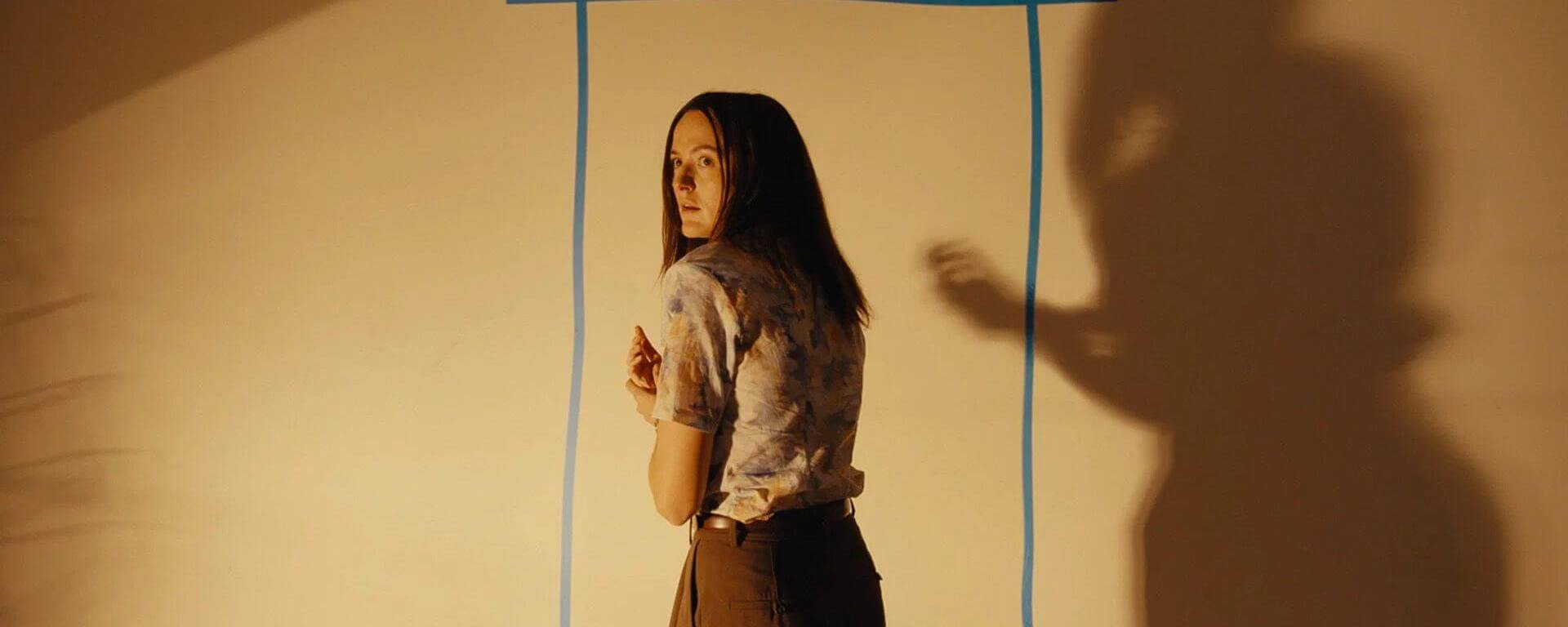
If you asked me ten years ago about horror based on internet lore, I would have rolled my eyes. Such not-so-great efforts like that awful Smiley film or something like Unfriended or the Slender Man movie. Films like that were cash grabs made by studios with little knowledge of internet culture and no interest beyond seeking a profit. If you asked me that one of the most unsettling movies to come out in a given year would be based on a backstory given to a grainy photograph, of course, I would have called you nuts. And yet here we are, and that grainy photograph has given rise to a genuinely unsettling cinematic experience, made by a 20-year-old YouTuber who went viral a few years ago.
Now, to understand what Backrooms is about, we need to explain what the concept is. Every culture has its share of stories, morality tales and urban legends. For me, it was stories about the babysitter and the man upstairs, the licked hand, or scraping on the roof of a car at Lover’s Lane. In the age of the internet, new stories started to emerge. The hook-handed mental patient gave way to Slender Man and so forth. One such story was that of the backrooms. All inspired by one photo of an empty office, the idea behind the Backrooms is that you ‘noclip’ out of reality. To ‘noclip’ is named for in a video game, where you fall through the bounds of the game world, glitching into a void. But if you do that in reality, you wind up in the Backrooms, a seemingly unending labyrinth of odd office architecture with various different realms and levels. And when you arrive, you may not be alone.
Backrooms as a concept intrigued me early on, but it really was Kane Parsons’ horrifying first short that made me a follower of the concept, and Parsons’ other works. That first short truly is a frightening experience, and shows early artistic talent by Parsons. He would later create several other horrifying shorts based around the Backrooms, as well as other shorts such as his equally unsettling Oldest View series. So when news came that it was him directing this project, I was on board. Internet personalities sometimes make the transition to cinema. Sometimes it goes over well, like with Iron Lung. Sometimes the reception is a bit more mixed, like with Shelby Oaks. What excited me about Parsons was his proven track record for quality horror shorts. Still, translating a nine-minute horror masterpiece into a feature-length film is no short order. Fortunately, Parsons manages to decorate this surreal world with compelling characters.
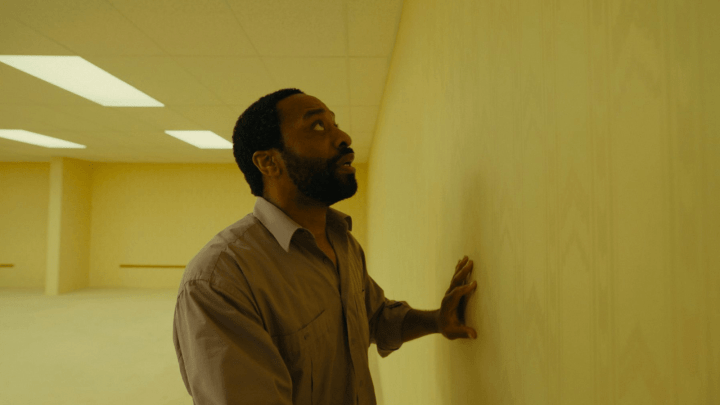
Set in the backdrop of the early 90s, Backrooms tells the story of Clark (Chiwetel Ejiofor), a businessman running a struggling furniture store, all while going through a bitter divorce. At a crossroads in his life, Clark seeks the advice of therapist Dr. Mary Kline (Renate Reinsve) to try and gain some perspective and healing. Things change when, in the basement of his store, Clark finds a doorway to another world. This world seems to be an endless maze of empty offices built in ways that make no sense. As he starts to explore the world, Clark can’t shake the feeling that something else may be lurking there.
Clark is not very likable, but this is only to the film’s benefit. Often with horror, a character’s flaw proves to be the catalyst for the plot, perhaps even a character’s downfall. In Clark’s case, it’s bitterness at dreams unlived and goals unmet, failures he holds over those around himself rather than looking inwards. Clark is angry, he’s angsty, he’s whiny, and he’s never not compelling. That Clark is so uniquely unlikable a character leads us to wonder just how he will react to the unfolding terrors around him. This story is something of a morality play, like classic episodes of The Twilight Zone, holding a mirror to its hero and offering judgment. What they do with that judgment is up to them.
Clark, upon discovering this world, becomes enamored with it, seeking to explore it. He angrily snaps at Mary for not believing his story, childishly saying she owes him an apology rather than really understanding just how surreal his story truly is. He entices two acquaintances into the world with him so they can explore, putting them at risk, while he, for the most part, tries to stay back from a distance. Like Jack Torrance before him is an unlikable man faced with a strange, unknown situation, one that only seems to drag him ever deeper. As we get deeper and deeper into the story, the world of Backrooms becomes increasingly impossible and surreal.
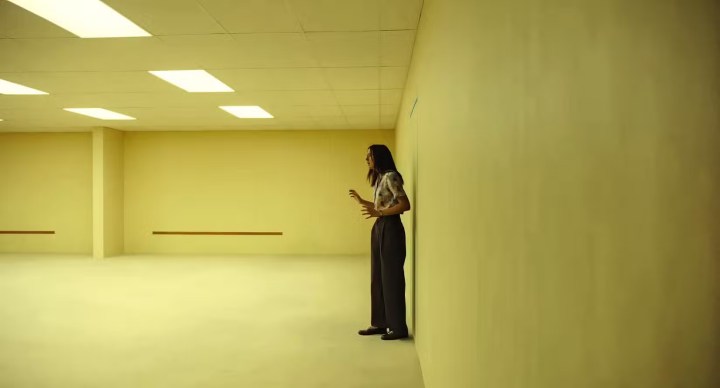
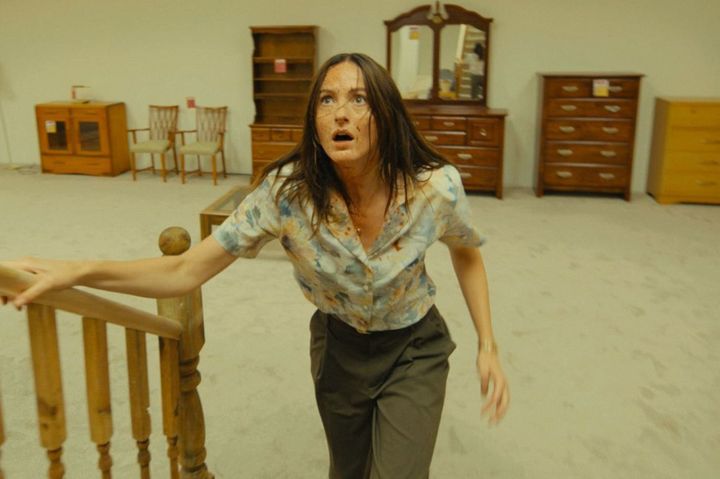
The mirror side to Clark is Mary, his doctor and the person I would argue is the moral center of the film. Rather than being an unfeeling counsellor, Mary is suffering from trauma of her own, having grown up with an abusive and paranoid mother and suffering lasting scars. Keenly aware of her own flaws, she tries to get Clark to see his own, only to be met with constant resistance. Mary is invested in her patients, enough to seek Clark out after he goes missing, leaving a cryptic message on her answering machine that leads her, you know, where. Characters enter the backrooms on camera around three times. The first time, Clark enters on his own. The second time, Clark and several other characters venture in. In these parts of the film, we see the story from Clark’s perspective, much like earlier parts of The Shining. But as things ramp up, we switch perspectives away from Clark and onto Mary, who carries us through the final act, and through some of the film’s most surreal imagery.
Whether or not you are interested in these characters really is what will determine the movie for you, because this is not a story about the Backrooms. It’s a story about how these two characters, the impact it has on them, and what it says about them. This is the real foundation of the movie, and it’s a strong enough foundation that even without the shorts that came before, Backrooms works as a self-contained story. We understand the concept, and the characters both have complete arcs. How does any of the story with Clark and Mary relate to the Backrooms? A lot of the greatest horror deals in things perhaps we don’t want to face, such as bad or even false memories.
The nature of the Backrooms doesn’t change, but how these two characters experience it gives it a framing specific to this story. The Backrooms, as the characters discuss, are a distortion of reality. Clark, as a character, has such a distorted view of himself, viewing himself as a victim rather than a victimizer. We recognize this in how he behaves. Whether he comes out of that spell is yet to be seen. The movie does have an extended found footage segment referencing his earlier works. It’s a nice touch for that part of the film and one of the film’s most effective moments. What this movie does that had not been accomplished before is really allow us to experience the surreal unreality of the backrooms with a cinematographer’s eye. Something about seeing the Backrooms created faithfully with real actors in such loving detail is, to me, a real marvel and a great highlight to the overall quality of this production. And thankfully, we are allowed to relish in these surreal sets and images.
Kane Parsons’ short films were largely comprised of digital assets created on his home computer, made to look real via the use of grainy VHS found footage. One of the things that is most shocking about this film is that much of Backrooms is actually comprised of physical sets here, allowing actors to move through the space in a way Parsons was unable to do in his earlier work. Mark that one as a win for practical effects. The set here will surely go down with other such iconic horror locations, such as the Nostromo in Alien.
When it comes to scares, you won’t do a lot of screaming with this movie. At least I didn’t. But it’s important to remember that there are different kinds of horror. Sometimes a scream isn’t really the goal. Backrooms doesn’t have very many jump scares, instead taking its time to build mood and atmosphere. These quiet moments of dread as the characters venture further and further into the mysterious space are where most of the film’s impact comes from, ratcheting up to fast-paced set pieces with characters on the run from things they can’t see, much less understand. It’s the kind of slow-burn horror I’d missed from such classics as The Shining or the original Halloween. This kind of horror, to me at least, revolves largely around the final act where the ideas of a story come together in a grand finale meant to thrill and chill. You may not scream out loud, but you will certainly squirm in your chair at this one.
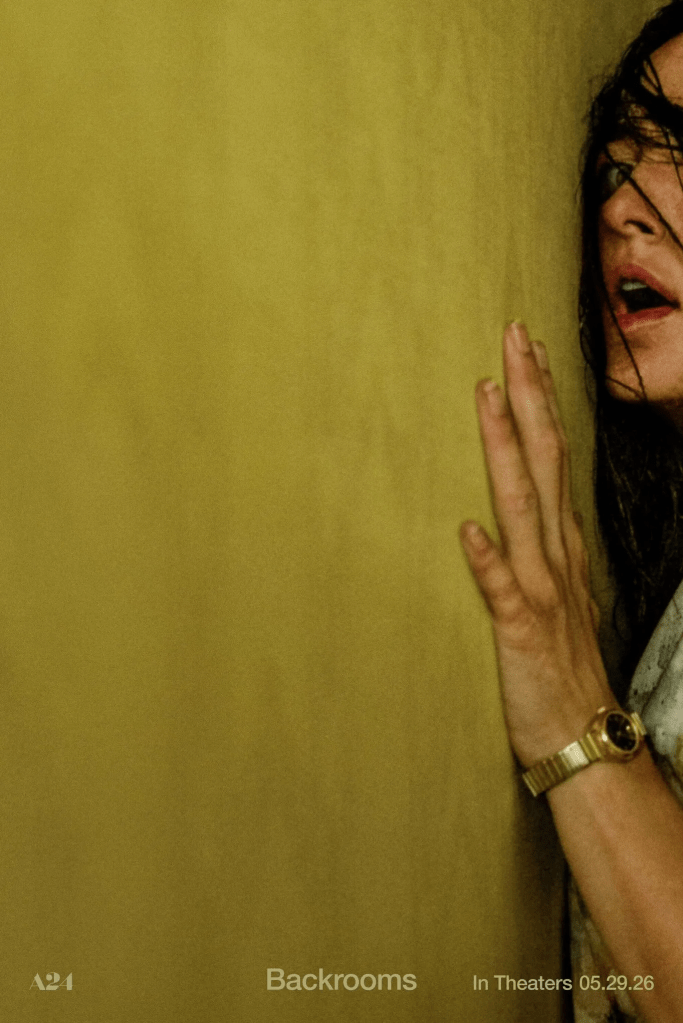
Parsons’ Backrooms is a surreal horror treat that, even for someone who still remembers the world pre-internet, is as effective a scary movie as you’ll get. The images here are surreal and unsettling, managing to capture the uncanny valley quality that previous adaptations, such as the not-so-great American Horror Stories episode on the Backrooms, failed to capture. Some images here border on physically uncomfortable to look at, with one such distorted image causing this viewer to go cross-eyed in the theater. To create images that in and of themselves don’t make sense is where the horror comes from, rather than gore or jump scares. Things we can’t, and in some cases don’t want to see. Horror comes in different flavors and intensities. Something like Creepshow is horror, but it is done with a deliberate pulp that makes it as fun as it is frightening. Something like Halloween tries to keep itself grounded and real, so the horror when it does arrive is that much more unsettling. Backrooms is not a screamer movie. But it will make you shiver and shudder, and if that feeling stays even after you walk out of the theater, then the movie has done its job. I, for one, am still shuddering.


One thought on “‘Backrooms’ Will Make You Shudder – ScreenHub Entertainment”